At a time when photovoltaics in the late 1980s were still largely the domain of research institutions, pilot projects and a few visionary individuals, Markus Eisenring took a step that was clearly ahead of its time. As early as June 1989, he commissioned one of Switzerland’s first privately owned, grid-connected 3 kW photovoltaic systems. At a time when solar power was still regarded as experimental and practical experience was scarce, he made this decision deliberately – not as a matter of economic routine, but out of conviction and a spirit of scientific curiosity. In Eastern Switzerland, this installation was among the very first of its kind.
At that point, neither established markets nor standardised installation concepts for private solar systems existed. Permits were complex, inverters were loud, expensive and technically immature, and reliable long-term experience was entirely lacking. Nevertheless, Markus Eisenring was convinced that this technology had a future – and that it could only progress if it was tested in practice, measured and consistently further developed.
A System as a Pilot and Demonstration Project
The 3 kW photovoltaic system on the roof of his detached house in Niederuzwil was designed as a pilot and demonstration installation. It showed at an early stage that photovoltaics do not merely work in theory, but can also be used reliably, safely and sustainably in the everyday life of a private household. Markus Eisenring thus became one of the pioneers of private solar power use in Switzerland.
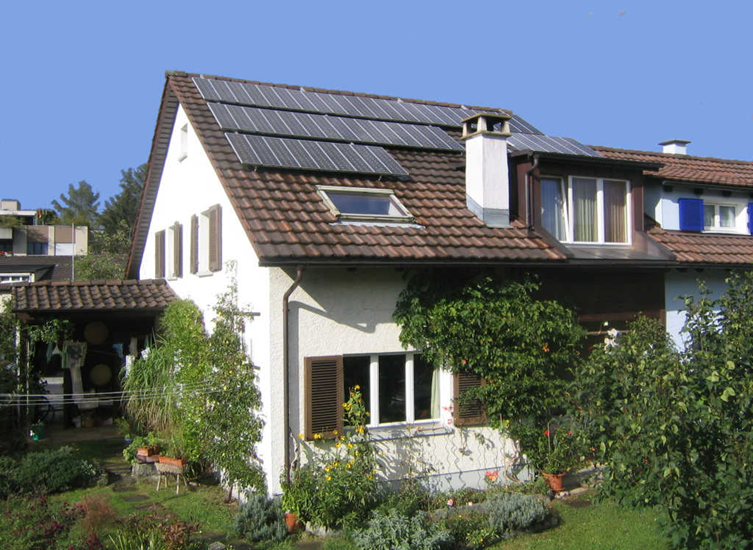
The photovoltaic system was deliberately designed as a standard installation: mounted on the roof of a terraced single-family house in Niederuzwil, south-facing and optimally inclined. From the very beginning, the system operated in grid-connected mode: the solar electricity generated was used directly in the house, surplus power was fed into the public grid, and any shortfall was drawn from the grid. This interaction effectively turned the electricity grid itself into a storage system – at the time a new and pioneering approach.
For many years the system ran almost without faults and provided valuable insights into:
- energy yields under real weather conditions
- efficiencies of modules and inverters
- seasonal and daily production fluctuations
- integration of solar power into existing grids
The extensive and consistently maintained data collection over several decades made the system one of the best-documented private photovoltaic installations of its time.
Solar Power for Household Use and Electric Mobility
A key motivation for building the photovoltaic system was the electric vehicle “Stromboli I”. The solar electricity not only supplied the detached house but was also deliberately used for electric mobility. Even in the early 1990s, many thousands of kilometres were driven each year using solar energy – at a time when electric mobility was still considered an exotic niche phenomenon.
What is particularly remarkable is that, despite the additional electricity demand of the electric vehicle, the photovoltaic system produced more energy than was consumed by the entire household. The early adoption of solar power and electric mobility therefore did not lead to higher net consumption, but on the contrary resulted in a net feed-in of renewable energy.
This clearly demonstrated that a holistic concept consisting of:
- local electricity generation
- efficient energy use
- and electrically powered mobility
is not only technically feasible, but also energetically sound.
Proof of the Everyday Practicality of Renewable Energy
The operating experience evaluated over many years showed that photovoltaics are:
- durable and reliable
- associated with minimal maintenance costs
- capable of making a relevant contribution to electricity supply
- and able to integrate harmoniously into existing buildings
It also became evident that solar electricity is produced particularly when electricity demand is high – for example during the daytime and at peak-load times. For electricity utilities and grids, this proved to be an advantage rather than a burden.
What is taken for granted today first had to be proven. The system installed by Markus Eisenring provided precisely this proof – well-founded, measurable and over many years.
A Base for Stromboli and Sustainable Energy
The 1989 photovoltaic system was more than a technical installation. It formed the practical foundation of the Stromboli project and an early example of how renewable energy and new mobility concepts can work together.
Markus Eisenring was thus part of that small group of pioneers who did not merely call for renewable energy, but actively implemented it themselves – long before it was politically supported or widely accepted by society. His work helped to dismantle prejudices, build confidence in the technology and pave the way for today’s solar and electric mobility solutions.
What began in 1989 with a private 3 kW photovoltaic system is more relevant today than ever: local solar power, intelligent grids and sustainable mobility – exactly the principles that Stromboli has stood for from the very beginning.