Since 2010, the Stromboli II has been powered by lithium batteries (LiFePO₄).
In 2022, the battery system was replaced with a new generation of
more advanced and higher-performance lithium batteries.
 |
+ |  |
||
| Lithium battery pack and advanced management Sytem management system |
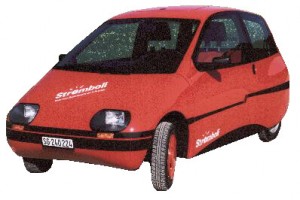
The Stromboli II ultra-light 4-seat Electric Vehicle with only 550 kg weight (without batteries) |
↓
Performance with Lithium Batteries (LiFePO₄)
Energy consumption < 100 Wh per km
Range > 400 km per battery charge
750,000 km per battery set
Maximum speed: 130 km/h
→ Everyday driving performance suitable for daily use
High-Tech Electric Vehicle STROMBOLI II
The STROMBOLI II is a unique, ultra-lightweight and everyday-capable high-tech electric vehicle and can be regarded as a benchmark for future low-energy vehicles. With a weight of only 550 kg without batteries, it meets a key prerequisite for its exceptional efficiency. In addition to its low mass, the vehicle impresses with an excellent drag coefficient (cw value), very good driving characteristics, high everyday usability, and pronounced safety and stability advantages.
This unique combination makes the Stromboli II an ideal platform for testing new battery technologies under real-world conditions.
Background: The Role of the Battery
For a long time, electric vehicles were limited by the characteristics of available batteries. These were large, heavy and expensive, offering only a limited energy content. As a result, range, performance and interior space were significantly compromised. Long charging times and limited battery life further led to high operating costs.
Another often underestimated aspect is that the general public is largely unaware of how little energy a consistently lightweight, small electric vehicle actually requires.
Why Stromboli II Was Equipped with New Batteries
The lithium batteries originally installed in 2010 provided over 12 years of daily operation. However, with increasing age, usable driving performance declined; in particular, winter range dropped to around 100 km.
At the same time, battery technology had advanced significantly during this period. For this reason, the battery system was replaced in 2022 with a new, more powerful generation of lithium batteries, allowing the full potential of the Stromboli II to be utilised once again and making technological progress clearly visible.
Battery Comparison: 2010 vs New Batteries
The comparison clearly illustrates what had already been achieved with modern battery technology by 2022:
| Energy content: | from | 22 kWh | to | 33 kWh | (+48 %) |
| Cell weight: | from | 246 kg | to | 139 kg | (-44 %) |
| Battery volume: | from | 162 dm³ | to | 61 dm³ | (-63 %) |
| Vehicle weight: | from | 850 kg | to | 743 kg | (-13 %) |
| Maximum range: | from | 230 km | up to | 435 km | (+89 %) |
With the new batteries, the Stromboli II now achieves a range of more than 400 km, using only slightly more than half of the previous battery weight.
Successfully Achieved Objectives
The new battery system has enabled several key objectives to be successfully realised:
- Proof that 4- to 5-seat ultra-light electric vehicles equipped with modern batteries can be long-range, fast and suitable for everyday use
- Successful integration and real-world testing of advanced batteries with a specially adapted battery management system
- Confirmation of high efficiency, with an energy consumption of less than 10 kWh per 100 km
- Increased motivation for the large-scale production of comparable vehicles through practical proof of feasibility
Thomas Kuster of Ingenieurbüro Kuster contributed significantly to the successful implementation of this project.
Outlook: Even More Advanced Battery Systems
New battery types, including future solid-state batteries, promise significantly improved performance. With the same battery weight, ranges of well over 1,000 km per charge appear realistic.
In addition, these batteries offer:
- A service life exceeding that of the vehicle itself
- Fast-charging capability, with charging times of approximately 5–10 minutes
- More than 200 km of range per minute of charging
The Stromboli II is ideally suited as a test vehicle for the practical evaluation of such battery systems and for demonstrating their full potential.
Second Life: Sustainability Through Battery Reuse
The retired 22 kWh lithium batteries were not disposed of. Despite their age, they still retain around two thirds of their original energy capacity.
In the interest of sustainability, they were given a second life as a residential energy storage system, now storing electricity generated by the in-house photovoltaic installation. This not only increases self-consumption and reduces reliance on the grid, but also demonstrates that second-life batteries can be used reliably and effectively.
For further information, we would be pleased to assist and invite technology partners to use the Stromboli II as a practical test platform for advanced battery technologies in everyday operation. We welcome enquiries regarding collaboration, testing and co-financing.
For information and details, we are gladly at your disposal and we shall accept offers for participation in this project by the contact form.